Clinical Pharmacology and Quantitative Sciences
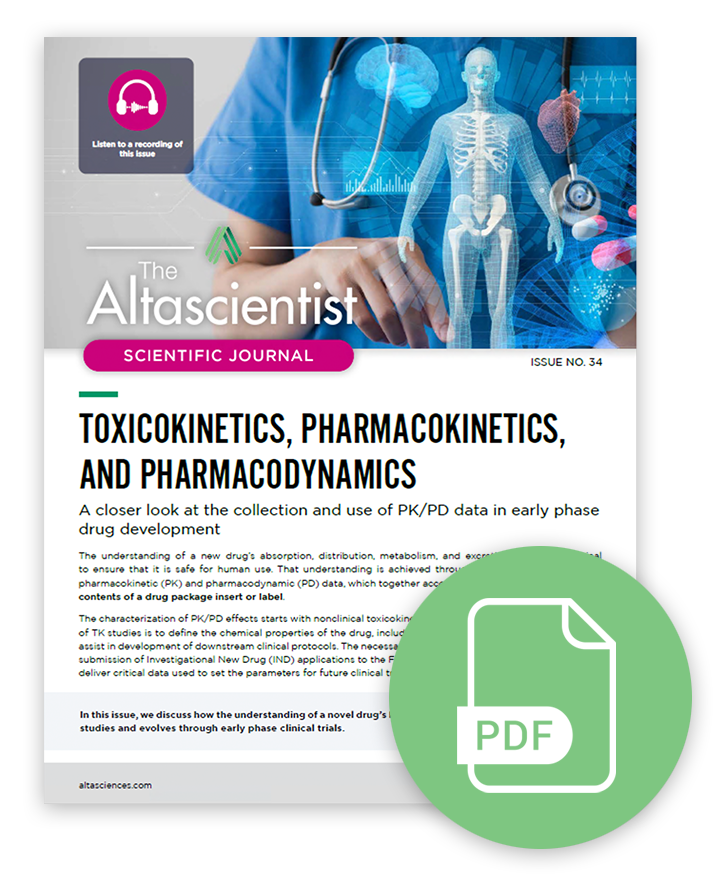
Early-phase drug development depends on the ability to connect data to decisions. Pharmacology, biostatistics, and modeling must work together to translate data into actionable insight across nonclinical and clinical studies.
Altasciences brings these disciplines together within a unified development platform, integrating pharmacokinetics, pharmacodynamics, toxicokinetics, biostatistics, and model-informed approaches to support faster, more confident decision-making across your program.
Model-Informed Pharmacology for Smarter Development Decisions
Our pharmacology team supports your drug development program throughout its entire lifecycle. By integrating model-informed drug development (MIDD) within our unified framework, we combine pharmacology expertise, study data, and advanced modeling and simulation to generate actionable insights that inform critical development decisions.
Our integrated approach helps you:
- Design more efficient studies and select clinically relevant endpoints
- Support dose selection and dose-escalation strategies using emerging PK/PD and safety data
- Characterize exposure-response relationships to better understand efficacy and safety drivers
- Evaluate interim data and refine development strategies as evidence emerges
- Translate nonclinical findings to clinical outcomes through predictive modeling and simulation
- Assess alternative development scenarios and trial designs before execution
- Inform proof-of-concept planning and key go/no-go decisions at critical milestones
Through quantitative analyses, model-based simulations, and data-driven decision support, we help reduce uncertainty, mitigate risk, and maximize the value of every study—enabling faster, more informed development decisions from first-in-human through proof of concept (POC) and beyond.
Nonclinical to Clinical Pharmacology Services
Our clinical pharmacology and quantitative sciences teams support a broad range of study designs and development stages, including:
- Nonclinical studies and translational research
- First-in-human and early clinical pharmacology studies
- Adaptive and fixed study designs, including dose escalation and expansion cohorts
- PK/PD-rich and biomarker-driven trials
- Early patient studies across therapeutic areas
We design integrated strategies that ensure pharmacology data, statistical outputs, and modeling insights work together to support efficient study execution and decision-making facilitating:
- Rapid interpretation of PK, PD, and safety data
- Timely support for dose escalation and cohort decisions
- Early identification of trends, risks, and opportunities
- Consistent data interpretation across studies and phases
- Alignment of quantitative insights with overall program strategy
Working closely with your team, we help you move from first-in-human through proof of concept with greater confidence and fewer delays.
Quantitative Sciences Across the Study Lifecycle
From study design through regulatory submission, Altasciences integrates pharmacology, biostatistics, and model-informed drug development expertise to generate actionable insights, support critical decisions, and accelerate development progress.
| Study Design and Strategy |
|
| Analysis Planning |
|
| Study Execution and Data Analysis |
|
| Data Integration and Interpretation |
|
| Submission-Ready Deliverables |
|
Explore Altasciences’ Full Range of Supporting CRO Services
Related Resources

FAQs
How can clinical pharmacology and quantitative sciences help reduce risk in early-phase drug development?
Clinical pharmacology and quantitative sciences provide a data-driven framework for understanding how a drug behaves in the body and how those effects relate to safety and efficacy outcomes. By integrating PK, PD, biostatistics, and model-informed approaches, sponsors can identify potential risks earlier, optimize study design, and make more informed development decisions.
How do model-informed approaches support dose selection and dose escalation decisions?
Model-informed drug development (MIDD) uses pharmacology data, statistical analyses, and simulation techniques to evaluate dosing scenarios before and during clinical studies. These insights can help optimize starting doses, support dose escalation strategies, characterize exposure-response relationships, and improve confidence in cohort progression decisions while maintaining participant safety.
How can pharmacology data improve the transition from nonclinical to clinical studies?
Translating nonclinical findings into clinical success is one of the greatest challenges in drug development. Integrated pharmacology and modeling strategies help bridge this gap by evaluating exposure-response relationships, predicting clinical outcomes, supporting first-in-human dose selection, and providing a stronger scientific foundation for study design and execution.
Why is it important to integrate pharmacology, biostatistics, and modeling throughout development?
When pharmacology, biostatistics, and modeling are aligned from study design through reporting, sponsors gain a more complete understanding of their data and program performance. This integrated approach can improve study efficiency, accelerate data interpretation, support adaptive decision-making, and help generate the evidence needed for key development milestones and regulatory interactions.
How can quantitative sciences help accelerate proof-of-concept decisions?
By combining PK/PD analyses, biomarker evaluation, statistical methods, and modeling insights, quantitative sciences teams can help sponsors assess emerging data more quickly and accurately. This enables earlier evaluation of proof of mechanism, dose-response relationships, and clinical potential, supporting timely go/no-go decisions and more efficient resource allocation.