Nonclinical Toxicology Studies
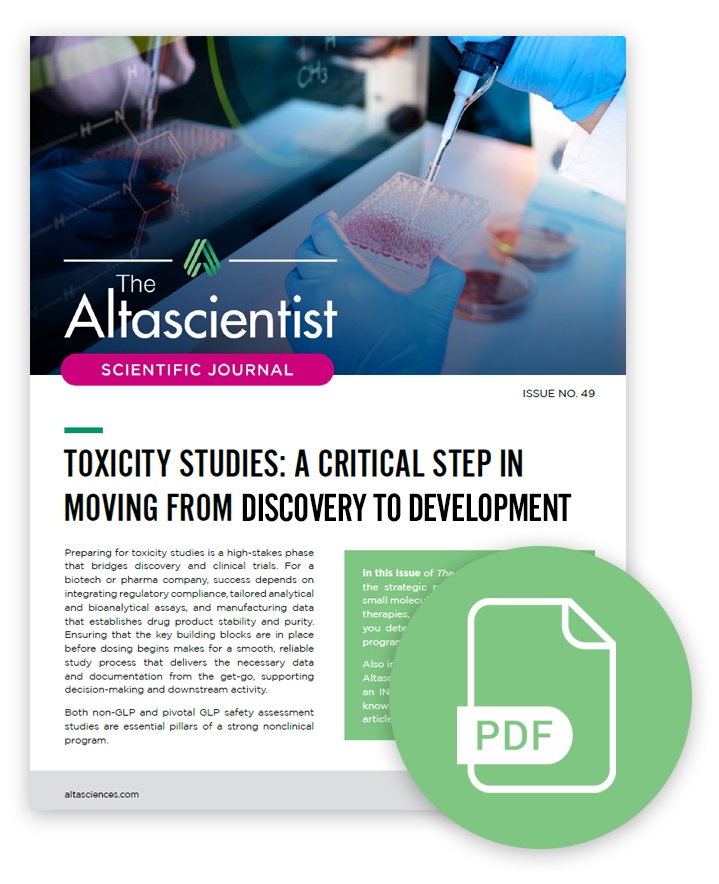
Transitioning from drug discovery to clinical trials depends on generating reliable, high-quality data, especially during IND-enabling toxicity studies. This step requires four key elements: a strong regulatory strategy aligned with GLP standards, careful selection of appropriate species and dosing levels, integrated analytical and bioanalytical methods to assess safety and pharmacokinetics, and robust CMC processes to ensure the drug is stable, pure, and ready for clinical use.
In Issue 49 of The Altascientist, we explore:
- Clarity on non-GLP vs. GLP studies and how to use each to de-risk your program and accelerate timelines
- A checklist to determine if your molecule is truly prepared for IND/CTA submission
- Key study design insights, from species and dose selection to bioanalytical and CMC alignment
- A real-world case study showing how an innovative study design overcame known pharmacological challenges and kept the program on track
Pre-Ind Toxicity Study Readiness
Before initiating toxicity study planning, a comprehensive review of existing data is essential to optimize study design and minimize regulatory hurdles. Leveraging cross-product benchmarking from established drug classes provides critical insights into previously observed safety signals, allowing for more targeted assessments.
Beyond class-specific data, our experts evaluate compounds with shared biological pathways to identify potential off-target effects. This strategic data synthesis ensures your nonclinical program is informed by historical safety signals, pathway homology, and regulatory benchmarking.
Optimizing the Glp Transition
The shift from non-GLP exploratory work to pivotal GLP toxicology is a critical determinant of a program’s net present value (NPV). While GLP studies are mandatory for an IND application, premature initiation can be detrimental to both budgets and timelines.
We focus on helping you avoid "technical debt" in your nonclinical program. If you initiate GLP studies before your CMC (Chemistry, Manufacturing, and Controls) process is locked, any subsequent tweak to the formulation or manufacturing profile can trigger a domino effect. These shifts often necessitate costly repeat studies or complex bridging data that can set your timeline back by months.
To avoid regulatory delays, pivotal GLP studies should only begin once your drug substance profile is stable. Ensuring your test article is truly representative of the intended clinical material isn’t just a best practice, it’s the most effective way to prevent avoidable regulatory delays and protect your budget.
Species Selection by Therapeutic Modality
Selecting an appropriate nonclinical model is a critical scientific exercise in ensuring toxicological data is truly predictive of human safety. Guided by ICH M3, S6, and S9 frameworks, the selection rationale must align with the drug’s unique molecular architecture and mechanism of action (MoA).
A scientifically robust program requires a data-driven justification for model selection, prioritizing pharmacologically relevant species that express the target and exhibit a metabolic or immunological profile comparable to humans. By integrating translational biomarkers and cross-species homology assessments early in development, we ensure your nonclinical safety package provides a high-fidelity risk assessment that stands up to global regulatory scrutiny.
Altasciences’ Expertise in Toxicology Studies
Drawing on decades of nonclinical safety assessment experience, we design toxicology programs that provide the robust, decision-enabling data required to define human safety margins. Our multidisciplinary teams, comprising board-certified toxicologists, DABVP veterinarians, and ACVP pathologists, integrate seamlessly with our bioanalytical labs to characterize toxicokinetic profiles and identify mechanistic safety signals early in the development lifecycle.
We deliver comprehensive GLP and non-GLP safety assessments tailored to your candidate's specific molecular modality and target biology. By prioritizing pharmacological relevance and translational modeling, we ensure your IND/CTA-enabling package is built on a strong scientific foundation, facilitating a streamlined transition from candidate selection to First-in-Human (FIH) clinical trials.
Explore all issues of The Altascientist in our Resource Center.
