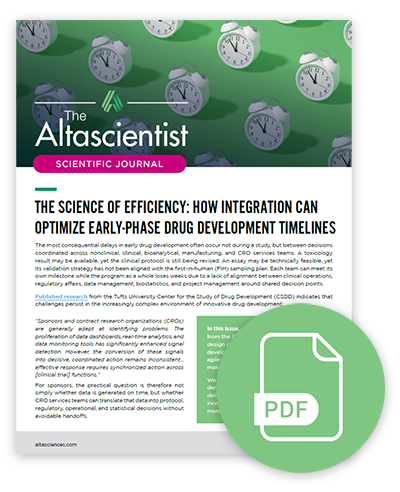
The Science of Efficiency: How Integration Can Optimize Early-Phase Drug Development Timelines
The most consequential delays in early drug development often occur between decisions. By aligning nonclinical, clinical, bioanalytical, manufacturing, and CRO services teams around shared milestones, sponsors can reduce avoidable handoffs, support timely decisions, and keep decisions, data, and execution moving together.
What You'll Learn:
- Where gaps between development stages create delays and why generating data on time is only part of the solution.
- How proactive planning and clear accountability help teams translate emerging data into coordinated action.
- including adaptive trial planning, parallel workstreams, and early regulatory alignment.
- The role of project management in multi-site trials, from identifying enrollment risks to coordinating data, teams, and decisions.
- How an integrated development strategy supported a novel incretin-based therapeutic, progressing from safety assessment to proof-of-concept topline results in 22 months.
Closing the Gaps Between Data and Decisions
Increasingly complex therapies require more sophisticated study designs, specialized testing, and coordinated execution. Even when individual teams meet their milestones, a program can lose valuable time if protocol development, assay validation, regulatory planning, and clinical operations are not aligned.
Effective integration goes beyond placing multiple services under one contract. It establishes evidence requirements, decision owners, escalation pathways, and shared performance expectations so teams can act on emerging data with greater speed and clarity.
Turning Integrated Planning Into Efficient Execution
Optimizing timelines requires a connected view of the critical path. Early risk indicators, proactive site engagement, and consistent communication help teams identify potential delays before they affect key milestones. Where dependencies allow, parallel activities—such as preparing regulatory documentation while nonclinical studies are ongoing—can reduce waiting time while maintaining scientific integrity and regulatory readiness.
For multi-site trials, project management connects internal functions and external sites through coordinated workflows, data oversight, and clear escalation pathways. This supports responsive decisions as cohorts, safety reviews, and study requirements evolve.
From Safety Assessment to Proof of Concept in 22 Months
A biotech developing a novel incretin-based therapeutic needed early PK/PD data to support formulation and funding decisions. Through the Altasciences Acceleration Platform, the program combined integrated planning, parallel bioanalytical and regulatory activities, and coordinated clinical execution.
The sponsor progressed from safety assessment to proof-of-concept topline readouts in 22 months, compared with the 27–51-month typical industry range cited in the issue. Read the full case study to explore the strategy and milestones behind this program.
How Altasciences Can Help
Reduce handoffs and keep interdependent activities moving together with Altasciences’ integrated early-phase drug development services. Our Altasciences Acceleration Platform connects nonclinical, clinical, bioanalytical, manufacturing, and CRO services through aligned planning and continuous program leadership.
Whether you need full-service, functional, or hybrid CRO support, one coordinated team brings shared development context, clear governance, and accountable execution to your program. The result is greater continuity and control, helping sponsors make informed development decisions and optimize study execution from early development through proof of concept.
Explore all issues of The Altascientist in our Resource Center.
Keep Your Program Moving Forward
Connect with our team about your early-phase development needs.
