Beyond the Cycle: The New Era of PCR in Translational Research
For years, Polymerase Chain Reaction (PCR) has been a foundational laboratory technique, valued for its reliability and versatility. But as we move deeper into the era of ultra-personalized genetic medicine, its role has evolved significantly.
 PCR is no longer just a tool for amplifying DNA. Today, it serves as a high-resolution lens, helping researchers track the kinetics and accumulation of cell and gene therapies (CGTs) as they transition from controlled lab environments into complex biological systems.
One of the biggest challenges in translational research has always been the gap between early discovery and clinical application, the so-called “valley of death.” Often, this gap is maintained by a lack of clear, actionable data. PCR helps bridge that divide by confirming that a therapy reached the appropriate tissues, persisted as intended, and elicited measurable biological activity.
The Shift to Digital: PCR Modalities in Modern Studies
The information researchers seek from PCR analyses has become increasingly specific as cell and gene therapies grow more complex. It’s no longer enough to confirm whether a genetic sequence exists; we need to understand how much there is, where it’s distributed, and how it persists over time.
Below are two primary PCR approaches that are shaping this level of insight.
qPCR: The Dependable Workhorse
Real-time quantitative PCR (qPCR) remains a foundational tool in many laboratories. By tracking fluorescence during amplification, qPCR generates real-time quantitative data that can support downstream applications, such as next-generation sequencing (NGS), or be used to determine the starting quantity of a target in a sample.
qPCR is frequently used to support biodistribution studies, helping researchers determine where gene therapies and delivery systems such as viral vectors (e.g., AAV) or lipid nanoparticles (LNPs) travel in the body and how long they persist.
dPCR and ddPCR: The Move to Absolute Precision
More recently, digital PCR (dPCR), and specifically droplet digital PCR (ddPCR), has introduced a new level of precision. Rather than quantification based on amplification curves, ddPCR partitions a sample into thousands of individual droplets. Each droplet becomes its own micro-reaction, allowing for absolute target quantification.
Put simply, qPCR quantifies relative to a reference, while ddPCR enables direct, absolute quantification.
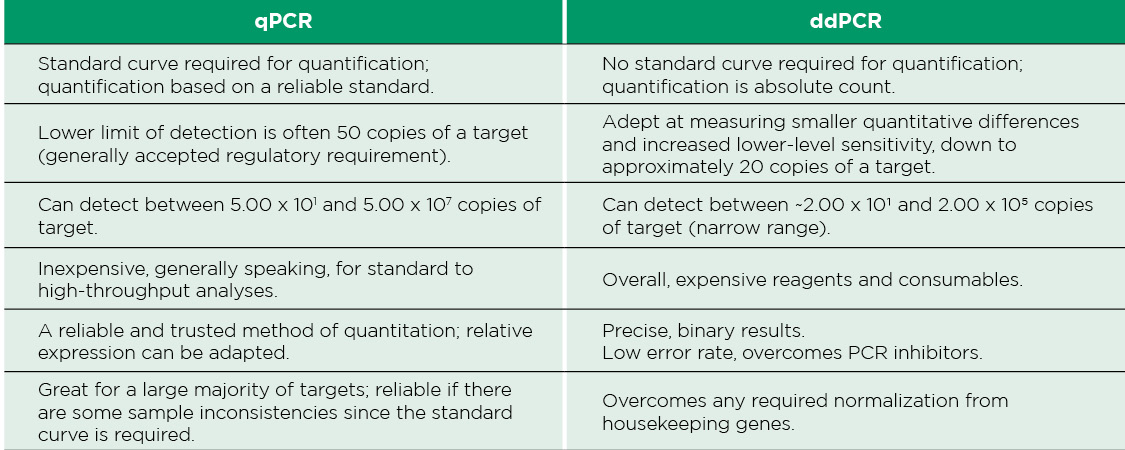
Please note that ddPCR is specifically a Bio-Rad platform
Engineering Success: Navigating the Complexity of CGT
Modern cell and gene therapy development requires researchers to evaluate more than the presence of a therapeutic; they must also assess its behavior, activity, and fate within complex biological systems.
Several factors now play a critical role in PCR-based bioanalysis:
- Matrix effects: Biological samples such as liver tissue or bone marrow can be complicated and variable, requiring careful preparation to avoid interference with results.
- Vector shedding: It is important not only to track where a therapy goes in the body, but also how it exits, through saliva, urine, or other routes, to inform safety and regulatory decisions.
- Active expression: Delivery of the therapeutic alone is not enough. Using RT-qPCR or RT-ddPCR, researchers can measure RNA to confirm that a delivered gene is actually being expressed and functioning as intended.
Looking Ahead: Automation and Integration
The future of PCR is not just about improving sensitivity—it’s about increasing efficiency of integration on target. Workflows are becoming more automated and multiplexed, allowing multiple genetic targets to be analyzed within a single reaction. This kind of advancement supports faster, more comprehensive analyses and helps generate the data needed to advance increasingly sophisticated therapies.
Precision Bioanalysis at Altasciences
In this evolving landscape, PCR plays a central role in characterizing gene therapy performance from the earliest stages of  development through clinical application. At Altasciences, bioanalytical approaches are designed to support that full journey—from initial vector analysis to detailed biodistribution studies.
By combining established methods like qPCR with more advanced techniques such as ddPCR, the goal is to generate clear, reliable data that informs decision-making through the lifecycle of the compound.
Discover how our PCR capabilities can support your therapeutic programs from early discovery to the clinical phases. Connect with one of our experts.
This article was first published in June 2026.
FAQ
What is PCR and why is it important in translational research?
PCR enables amplification of minute DNA or RNA quantities, supporting sensitive detection of biomarkers used to evaluate drug safety, efficacy, and disease progression, making it a foundational tool in modern therapeutic development pipelines.
What is the difference between qPCR and dPCR?
qPCR quantifies nucleic acid levels during amplification using fluorescence signals and a standard curve or reference gene, whereas dPCR partitions samples into many reactions and directly quantifies target copy number.
How is PCR used in cell and gene therapy development?
PCR-based assays are widely applied to quantify viral vectors, monitor gene expression, and validate molecular endpoints, all helping to ensure therapies achieve intended biological effects and meet regulatory expectations in drug development programs.
What are the main challenges of using PCR in research?
PCR accuracy can be affected by amplification efficiency, inhibitors, and variability in sample preparation, requiring rigorous assay validation, appropriate controls, and standardized workflows to ensure reproducible, regulatory-compliant results.