Case Study: Applying Scientific Expertise to Optimize Complex Safety-Focused DDI Studies
Drug-drug interactions (DDIs) can pose significant safety risks, particularly in cardiovascular therapies, where patients are often on multiple medications. By analyzing these interactions early, we can help your studies stay on track and avoid potential regulatory roadblocks.
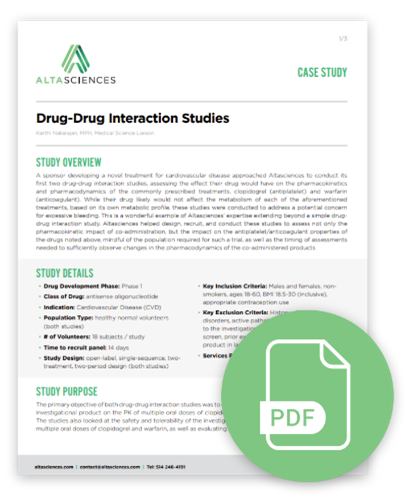
A sponsor developing a novel cardiovascular antisense oligonucleotide (ASO) treatment approached Altasciences to conduct its first two DDI studies. The primary objective of the study was to assess the effect their drug would have on the pharmacokinetics (PK) and pharmacodynamics (PD) of the commonly prescribed treatments, clopidogrel (antiplatelet) and warfarin (anticoagulant) in healthy adult subjects, when two doses were co-administered.
Altasciences helped design, recruit, and conduct these studies to assess the PK impact of co-administration, and the impact on the antiplatelet/anticoagulant properties of the drugs. It was crucial to be aware of the population needed for such a trial, as well as the timing of assessments required to observe changes in the pharmacodynamics of the co-administered products.
While the investigational product was not expected to alter the metabolism of these drugs, regulatory requirements and patient safety concerns required thorough assessment to ensure that co-administration would not increase bleeding risks. The information gleaned from these studies allowed us to support the product’s advancement into later clinical phases.
TARGETED, EFFICIENT, DRUG-DRUG INTERACTION STUDY DESIGN
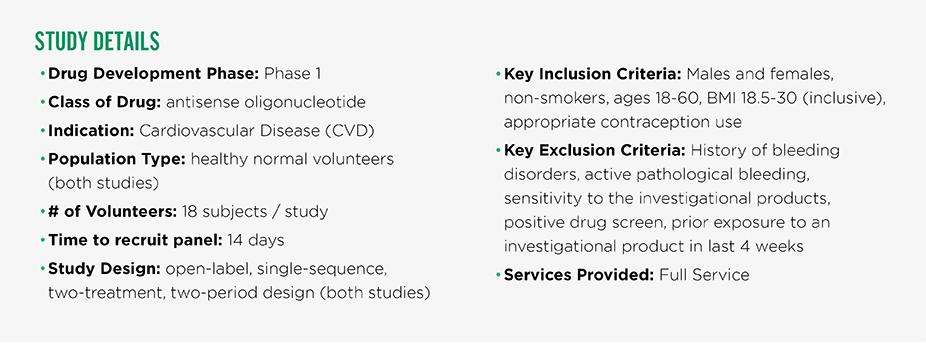
We designed and conducted two open-label, single-sequence, two-treatment, two-period studies in healthy normal volunteers (HNVs). Each study included 18 participants, screened carefully to meet the inclusion criteria: adults aged 18 to 60 with a BMI between 18.5 and 30, non-smokers, with appropriate contraception use. Exclusion criteria ruled out any history of bleeding disorders, active pathological bleeding, sensitivities to the investigational products, or prior exposure to an investigational
product in the four weeks prior.
The studies were conducted under controlled clinical conditions with close safety monitoring, leveraging our integrated early-phase capabilities in study design, recruitment, PK sampling, and bioanalysis. This collaborative and streamlined approach allowed rapid startup and consistent data delivery across both protocols.
STUDY METHODS: ASSESSING THE DRUG-DRUG INTERACTIONS OF CLOPIDOGREL AND WARFARIN
While the overall objectives and the inclusion/exclusion criteria of both studies were the same, the methodology for each trial was different. This was due to the differences in the activity and half-life of both drugs, which required slightly different washout periods and dosing schedules.
The Clopidogrel Interaction Study
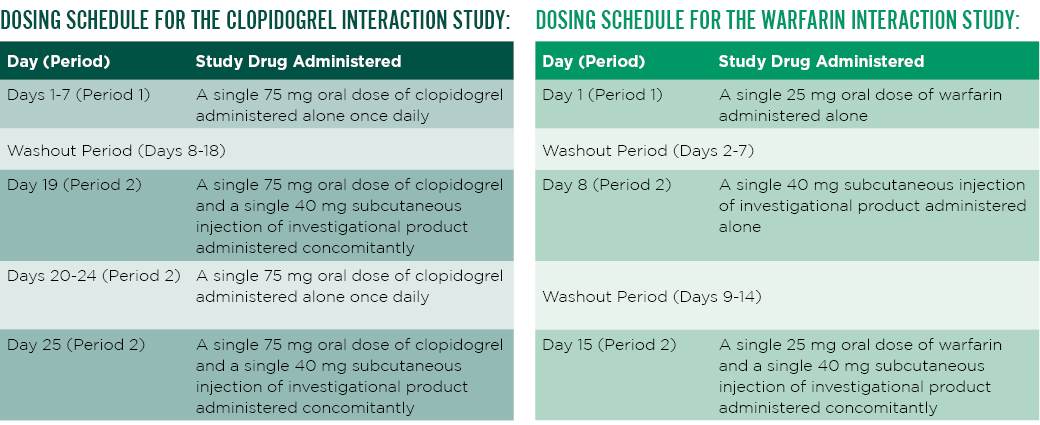
The clopidogrel study evaluated how the investigational product affected the PK and PD of multiple oral doses. Participants were confined to the clinic for nine nights in each period, for a total of 18 overnights. Period 1 consisted of seven days of clopidogrel dosing alone, followed by an 11-day washout before co-administration in Period 2. Pharmacokinetic blood samples were taken 13 times during both periods, from pre-dose through hour 48 (two days post-dose), to assess full plasma concentration profiles.
In addition, seven PD blood draws were conducted; two during individual administration of each product and five during co-administration, to analyze ADP-induced platelet function. This combined PK/PD approach enabled a full characterization of any potential interaction while maintaining participant safety and comfort throughout the study.
The Warfarin Interaction Study
The warfarin study followed a similar two-period design, focused on single-dose PK evaluation. Participants were confined for 13 overnights. Three nights during Period 1, three additional nights between periods, and seven nights during Period 2. PK blood samples were collected through hour 144 (six days post-dose) to evaluate both warfarin and investigational product exposure.
Specifically, 17 samples were taken to assess warfarin-alone PK in Period 1: 13 samples to assess investigational product pharmacokinetics at the start of Period 2, and another 17 samples to assess co-administration levels. PD assessments included 12 blood draws to evaluate platelet function using hematology parameters: activated partial thromboplastin time (aPTT), prothrombin time (PT), and international normalized ratio (INR). Safety labs and adverse events were closely monitored and evaluated throughout.
RESULTS OF THIS DDI STUDY
Both studies were conducted in a single-subject panel, allowing for efficient completion of the clinic portion of the trial. Following multiple doses of the investigational product, no clinically significant effects were observed on the PK and PD effects of clopidogrel. The warfarin study showed that co-administration with the investigational product did not affect the peak concentration or extent of exposure of either product.
Additionally, the maximum observed effect and the area under the effect-time curve for the pharmacodynamics lab parameters were not significantly affected by dosing both products together.
Both studies reported no serious adverse events, and all vital signs, ECG readings, and physical examination results remained within normal, clinically acceptable ranges.
ALTASCIENCES’ SCIENTIFIC COLLABORATION AND OPERATIONAL EXCELLENCE
Altasciences was tasked with conducting two studies involving a new molecular entity in combination with another drug that had the potential to cause a serious adverse effect on subjects. While it may have been easier or less costly to simply replicate the studies, or perhaps combine them, our project team worked with the client to design two different studies, with different timepoints of measurements, which had the same objectives.
In doing so, the client gained efficiencies of working with the same team across both projects and developed close partnerships, through which we were able to better understand our client’s, goals and work to achieve them in the best way possible. Both studies were treated with the utmost care, from study design and recruitment to clinic conduct and data management, and all the way through biostatistical analysis and report writing.
With our experience in handling complex DDI studies, sponsors benefit from streamlined processes, reliable data, and expertise in navigating regulatory and operational challenges. The DDI case study highlights how this scientific and operational proficiency helps mitigate risk, accelerate timelines, and provide actionable insights for safe and effective therapies.
Is your program in need of DDI studies? Get in touch to get started.