Case Study: How We Helped a Sponsor Go From Safety Assessment to Proof-Of-Concept in 22 Months
For sponsors advancing novel therapeutics, development timelines directly influence strategic milestones, investor confidence, and how quickly programs can progress toward clinical validation. Acceleration impacts not only the pace of development, but also how early key decisions can be made, and how much flexibility remains as programs advance.
In early-phase drug development, delays are often introduced not by the studies themselves, but by the operational gaps (the “whitespace”) between bioanalytical, nonclinical, regulatory, and clinical activities.
When these functions progress sequentially across disparate contract research organizations (CROs), transitions between stages can create avoidable delays that extend overall timelines by months, which can have significant consequences for programs working toward internal planning objectives or investor-driven milestones.
We helped a biotech developing an incretin-based injectable overcome this challenge. Rather than treating each phase of development as a separate handoff between teams, we designed an integrated strategy that saw their program go from safety assessment to proof-of-concept (POC) topline readouts in approximately 22 months—significantly faster than timelines commonly reported for comparable programs, which normally range between 27 and 51 months.
In this blog, we share exactly how we achieved this accelerated timeline.
The Study Objective
The sponsor of the therapeutic needed to reach POC on an accelerated timeline to hit a critical value-inflection milestone. Driven by capital constraints and competitive pressure, early pharmacokinetic/pharmacodynamic (PK/PD) data was needed urgently, along with a drug development partner capable of delivering both speed and accuracy.
In addition to accelerated timelines, the sponsor needed continuous visibility into emerging data to support internal decision-making and key business milestones. Meeting these objectives required more than working faster—it required a development model that connected functions within one coordinated framework and provided real-time insight into study progress and results.
Building an Integrated Development Strategy
With the primary challenge being the whitespace between stages, we employed the Altasciences Acceleration Platform to align nonclinical, bioanalytical, and clinical milestones within a unified roadmap from study initiation, providing a clear path from safety assessment through clinical development.
Bioanalytical method development, including PK and immunogenicity assays, was initiated at study award and advanced alongside nonclinical and clinical protocol development and regulatory preparation. This ensured analytical readiness as soon as samples became available, providing the data needed to support regulatory progression, clinical startup activities, and dose-escalation planning throughout the program. Toxicology studies were designed to characterize safety and pharmacologically driven effects commonly associated with metabolic therapies, including changes in body weight.
These findings would directly inform first-in-human (FIH) dose selection and escalation strategies, reducing uncertainty during the transition from nonclinical into clinical development.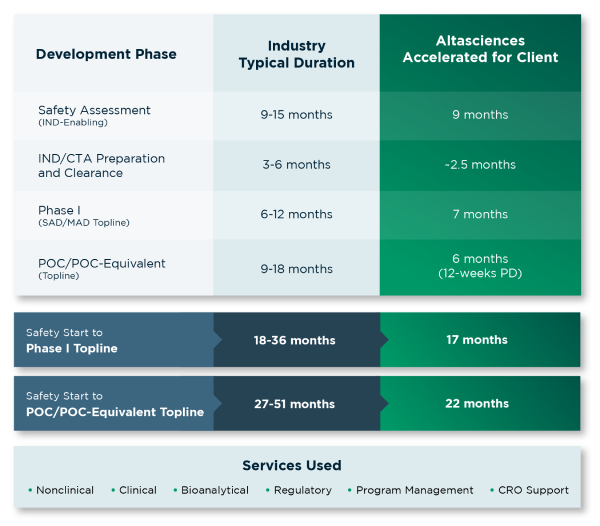
At the same time, regulatory and clinical planning advanced with the benefit of emerging nonclinical findings. Decision points were mapped early to maintain alignment across functions and allow data to inform later-stage planning as it became available.
As data emerged, it was incorporated directly into the Investigator’s Brochure (IB), protocol development, and submission planning, allowing the program to advance smoothly from data generation into submission readiness and clinical startup. The program also benefited from being conducted in Canada, where the Clinical Trial Application (CTA) submission took place approximately six weeks ahead of the corresponding IND submission timeline, accelerating site activation and study startup.
Results: Accelerated Progression to Proof-of-Concept
Using the Acceleration Platform, Altasciences was able to help the sponsor progress from first safety assessment to clinical proof-of-concept topline readouts in approximately 22 months, ahead of the typical 27 to 51 month industry timelines for comparable programs (depending on clinical design, regulatory requirements, and overall development strategy).
Importantly, these timeline gains were achieved without reducing scientific or regulatory standards. Instead, acceleration was achieved by coordinating development activities early, maintaining continuous communication across functions, eliminating avoidable downtime between stages, and working very closely with our sponsor to ensure speedy communication and decision-making.
The value of this accelerated pathway extended beyond operational efficiency alone. Reaching proof-of-concept ~29 months ahead of industry norms unlocked critical program funding. For example, after approximately nine months into the program, the client was able to issue a high-visibility Phase IIa press release, strengthening investor confidence and reinforcing their competitive position in the incretin landscape.
Every month saved before POC shortened the timeline to generating clinically meaningful data, helping the sponsor reach important value-creation milestones sooner, reduce the time to potential return on investment, and maximize the commercial value available within the patent life of the asset.
Conclusion
Speeding up drug development only truly matters if you can see the results where they count. We are talking about hitting IND-readiness faster, unlocking Phase I data sooner, and securing POC milestones well ahead of industry norms.
By establishing analytical readiness early and aligning decision points across teams right at study initiation, we allowed regulatory and clinical planning to evolve seamlessly alongside ongoing nonclinical work, reducing the common bottlenecks and enabling sponsors to advance programs at an unprecedented pace.
In short, what this case study illustrates is how development pathways can be deliberately structured to reduce operational delays and support faster progression through critical milestones.
Interested in seeing how we could achieve the same for you? Get in touch to learn how the Altasciences Acceleration Platform can help you reach your critical milestones, sooner.
This article was originally published in June 2026.
FAQ: Accelerated Drug Development
What is the Altasciences Acceleration Platform?
The Acceleration Platform is an early-phase drug development model designed to reduce timelines through coordinated execution across nonclinical, bioanalytical, manufacturing, regulatory, and clinical services. By aligning scientific and operational teams within a single framework, the platform enables faster progression from first safety assessment to clinical proof-of-concept.
How can drug development timelines be shortened without increasing risk?
Timelines can be reduced by improving coordination across functions, enabling earlier data availability, and advancing regulatory planning alongside ongoing studies, while maintaining the same scientific and regulatory standards. Working with an integrated CRO/CDMO and Drug Development Organization, such as Altasciences, also helps reduce delays by consolidating multiple stages of development within a single coordinated framework.
How do traditional early-phase drug development timelines compare with Altasciences’ Acceleration Platform?
Typically, timelines can range from 18 to 36 months to reach Phase I data and 27–51 months to reach proof-of-concept from safety assessment. Integrated approaches, like the Altasciences Acceleration Platform, can reduce these timelines significantly, depending on molecule class, toxicology design, clinical strategy, and communication strategy.